
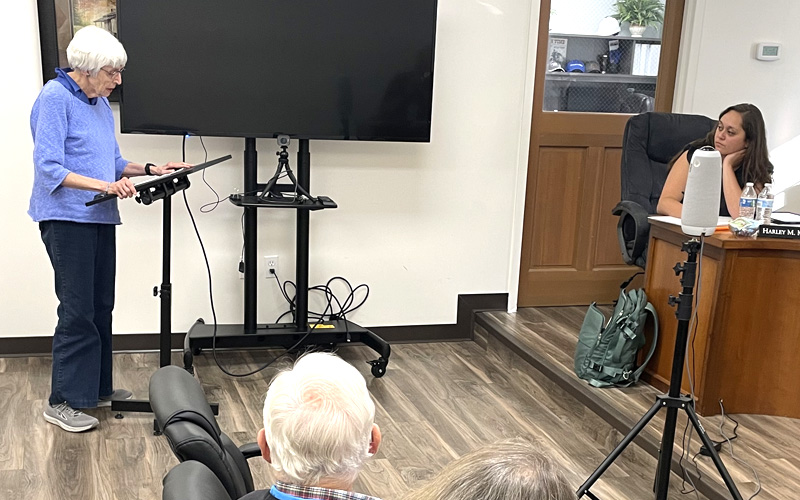
Several people signed up for public comment at both the Spruce Pine Town Council last week and the Mitchell County Board of Commissioners before that, concerned about provisions in a proposed contract for the new Toe River Regional Library.
Sharon Winters, a retired librarian and Mitchell resident, spoke first at the commissioners’ meeting.
“I was only able to review the agreement after it was approved last month,” Winters said. “I really want the new regional library system to succeed and effectively meet the needs of our residents.”
The Toe River Regional Library is an agreement that will replace the AMY (Avery Mitchell Yancey) Regional Library in July, after Yancey County officially withdraws from the AMY agreement. The new regional library will connect library branches in Mitchell and Avery counties.
Winters said that she has spoken with the Foundation for Individual Rights and Expression (FIRE) and the American Library Association (ALA) about the specific terms of the new Toe River agreement.
“Both organizations raised concerns that certain provisions in the agreement would violate First Amendment rights of library patrons or employees,” Winters said.
On June 2, the Philadelphia-based FIRE sent a letter to the commissioners outlining the organization’s concerns. It singled out provisions in the proposed agreement instructing the library’s Board of Trustees to judge library materials based on “standards of community decency” and requiring the library director to “not become involved in party politics, nor engage in discussion or debate of political issues.”
FIRE’s letter said that “the ‘community decency’ standard violates library patron’ First Amendment rights.” The letter further said that the free-speech rights outlined in the First Amendment to the U.S. Constitution “apply to restrictions on both self-expression and access to information.”
“The Supreme Court has long recognized that the First Amendment protects not only the right to speak, but also the ‘right to receive information and ideas.’ This right includes access to information in public libraries, the ‘quintessential locus of the receipt of information.’”
At the county meeting, Winters suggested that there are more objective standards that the library could use to judge what books and other materials to purchase.
“The best way to approach this would be to set policy that defines selection criteria for materials using standards like currency, relevance, authoritativeness and community interest,” she said.
Kendall Reid, also a retired librarian and Mitchell resident spoke at both the county commissioners’ meeting and the Spruce Pine council meeting.
“The Toe River Valley Regional Library Agreement does not explicitly recognize the regional librarian’s expertise,” Reid said at the county meeting.
At the Spruce Pine meeting, Reid echoed Winters’ concerns about objective criteria.
“Please remove references to the term community decency and ask the new board and library director to develop a collection development policy with specific objective criteria, such as currency, relevance, authoritativeness, and community interest,” he said.
Steve Rowland, current chairman of the board for the Mitchell County Library in Bakersville, spoke during public comment at the county commissioners’ meeting as well. Rowland said that he did not want to comment specifically on the new agreement, but rather to note that current policies regulating the library in Bakersville have worked out well.
“We got thrown into a fray due to some employee issues in other libraries which have been addressed by the policy changes we made last year within what was then the AMY library system,” Rowland said.
Rowland said that after conflict arose last year between the Yancey County Board of Commissioners and staff at the Yancey County Library, policy changes were made that improved practices at the Mitchell County Library, changes that required staff members to clarify whether or not they were speaking personally or on behalf of the library on social media and that regulated public displays.
“Those (public displays) had to be approved by the regional director,” Rowland said. “They couldn’t be put up without a review process, and that seems to have been working well. … I would hope you would carefully consider what’s been put before you and take another look at it and get some input from librarians as well as some of the board members.”