
Beginning on Friday, Sept. 27, 2024, while Tropical Storm Helene was pummeling the area, Blue Ridge Regional Hospital lost its communication system both inside and outside of the hospital. But by 8 p.m. on Sunday, the hospital was back online.
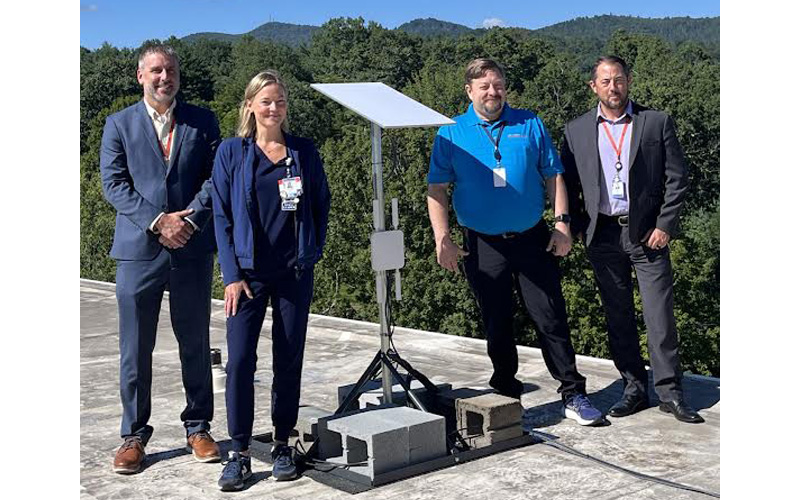
Joe Seely, a wireless architect for HCA Healthcare, was flown in from Tennessee and worked for several hours to restore the hospital’s information technology system. The experience motivated Seely to develop BlueNet, a satellite-based system that is designed to avoid any future communication blackouts. Seely’s new system became operational at BRRH on Aug. 27.
“The whole purpose of BlueNet is so that we never have a situation where someone can’t call for help again,” Seely said. “It is keeping the doors of the facilities open. To keep the doors of the facilities open, we have to be able to make a phone call, and we have to have our EMR (electronic medical records) systems online.”
While the system may not prevent all “acts of God” from shutting down communications, the system is “super reliable,” Seely said. “The likelihood of having a meteor strike, an earthquake, and a flood at the same time is not likely ... we can withstand two of those, but not all.”
BlueNet utilizes Starlink, a satellite internet-based service operated by Starlink Services, LLC, which bolsters its already existing internet connections.
“We put in extra connectivity so we’re leveraging 5G technology as well as low-earth orbit satellite technologies (like Starlink) in internet services. And then we’re leveraging the local internet circuits that are on site as well,” Seely explained. “This is just pulling all of our connectivity options that we have in a facility on top of new ones that we’re currently installing ... so that we can keep communications up.”
BlueNet will not cover the hospital’s guest networks, but phones in the patient’s rooms will stay online, and the system also allows for some outages to be fixed remotely, Seely said.
During the pilot phase — and in addition to the upgrade at BRRH — HCA Healthcare plans to eventually equip 200 of its hospitals nationwide with BlueNet.
When BRRH lost all its communication systems — which affected all of the hospital’s departments as well as its EMS crews — the staff stepped up and found ways to keep offering care.
Carrie James, RN, who lives in Yancey County and is married with three girls, has worked at BRRH for 15 years and was working in the ER the night of the storm.
“Like my staff in the Mission system, I was asked to be prepared to stay in the hospital before the storm,” she said. “So, I was here on Thursday for my shift, spent the night here, like many staff did. And then as soon as the storm hit on Friday morning, we lost all communication and had zero ability to communicate with the outside world.”
One of James’ jobs as an emergency-department clinical nurse coordinator is to manage patients coming into and out of the department.
“It was extremely difficult not to have any notification of EMS units arriving at the department. We also experienced an extreme flood of patients coming through triage and also people sheltering here at the hospital,” she said.
Coordinating all of those people’s needs became quite difficult.
“Losing communications and the use of our electronic medical record system was also very stressful,” James said. “We had no way to communicate even within the hospital.”
But the staff was able to implement workarounds.
“We did have walkie-talkies that I dispersed throughout the hospital to communicate with the various departments like acute care, the hospitalist upstairs, the pharmacy for medications, and the lab for results,” James added.
Despite the difficulties, the staff worked together. They crafted one system where the doctor would write the order, they would submit it to the pharmacy, and the pharmacist who had been on duty since the storm would bring them the medications to dispense to the patients, James explained.
They were also able to treat critical-care patients without the equipment they would normally use.
“We did have two patients who required ventilators during the storm, and so the nurses and doctors worked tirelessly to assist those patients and get them to a higher level of care despite the situation we were dealing with,” James reassured.
The only news the staff was receiving about what was going on in the community came from its EMS partners, who were bringing in patients.
Hours had passed before James learned that her family was okay.
“I had no way to communicate with my family and didn’t know if they were safe or alive. I was here until I got word that I was able to travel home over a bridge that had been decimated,” she said.
On Saturday, she left the hospital but had to climb down a ladder to get over the bridge to her home.
“I live along the South Toe River, thankfully, my home was okay,” she said.
Having a system that may prevent future communication failures is a relief for those at BRRH who experienced the recent collapse.
“I think that this BlueNet system is going to be imperative for us going forward,” James said. “I’m grateful for the support that HCA supplied us in the days post-Helene and during. We are a resilient community and certainly resilient staff here at Blue Ridge and within the Mission system. So, we are extremely excited for BlueNet to be implemented here.”