
Heading across the Highland Avenue Bridge toward downtown Spruce Pine last Saturday morning, a pungent note of coal smoke filled the air. In the distance, Lower Street (Locust Avenue) had become an encampment of black-smiths for the annual Fire on the Mountain Festival, a partnership event organized by Spruce Pine Main Street, Penland School of Crafts, and Toe River Arts.
A large crowd began to gather early, as 40 vendors’ booths opened to display the work of participating iron and metal artists, while others offered blacksmithing demonstrations, or, in the case of Penland School, provided lessons for beginners and staged smithing competitions. Two large demonstration areas were also constructed for the festival’s headlining smiths, one in downtown’s Pocket Park and the other midway down Locust.
At the east end of the street, the Mitchell County Historical Society’s booth provided the backstory for the area’s importance as a blacksmithing center, especially Spruce Pine’s connection to the Boone Brothers and their descendants: master blacksmiths who furnished everything from the Biltmore Estate in Asheville to Colonial Williamsburg in Virginia with craftsman metal and iron work.
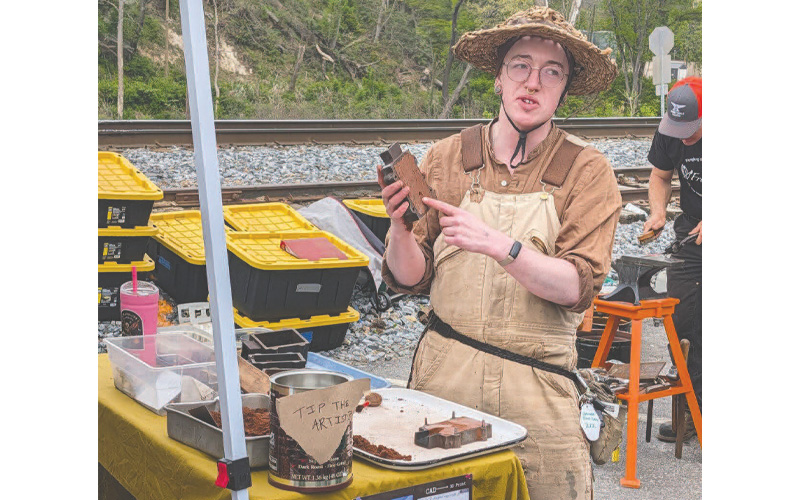
Atlanta-based metal artist Jay Reddish was describing his sand-casting techniques for creating jewelry from scrap and recycled metal.
“This is my second time in Spruce Pine,” Reddish said. “My sister and I came up for the Hellbender Festival last fall, and I knew I had to return.”
Penland had always been a draw for Reddish, but participating at Fire on the Mountain convinced him that he needed to spend more time here.
“It’s amazing to be in a place where people know exactly what you’re attempting to do, and who have the vocabulary to challenge you in good ways,” Reddish added. “This is a unique place.”
Universities offering degrees in metalworking and blacksmithing were also in attendance, showcasing student work and providing brochures on their programs. Master of fine arts degree candidate Hannah Litt oversaw the Southern Illinois University booth for her second year at the festival. “Our department home-base in Carbondale has many ties with Penland and this area,” Litt said. “We’re always eager to come back here and work.”
Litt, along with the Columbus, Ga. based metal artist Kat Cole, Penland’s Autumn Brown, and veteran festival organizer and pioneering blacksmith Elizabeth Brim, clearly demonstrated that the anvil and forge were no longer commanded by just men. A number of young female smiths were eagerly taking notes during their demonstrations.
The first substantial rainstorm of the month arrived around 1:30 p.m. Booths started to close early, and the crowd began to thin, thoughmanystalwartsstayed on.
After two hours of downpour, Brim was still at her forge, demonstrating her inflation technique for internally expanding iron in such a way that it finally resembles a fluffy pillow (this particular method of Brim’s can be seen in her work at the Mint Museum in Charlotte and the Smithsonian’s Renwick Museum in Washington, D.C.).
No cloudburst was going to fully douse the Fire on the Mountain.