
Waterway clean up could be $100 million
Mariel Williams
editor@mitchellnews.com
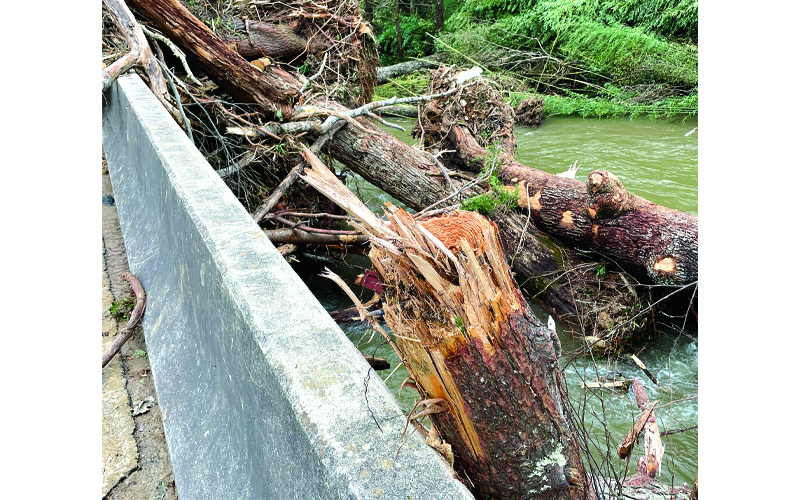
The Mitchell County Board of Commissioners voted to table making a decision on how to remove debris from waterways at its meeting last week.
County Manager Allen Cook said that he believes further research is needed to decide if it would be best to hire a private contractor for waterway debris or if the U.S. Army Corps of Engineers could offer a better option.
The county currently has a contract in place with Southern Disaster Recovery to remove storm debris from the right-of-way on state and town roads, and the same company has offered to take on stream debris as well.
“Our waterways have a lot of debris from the storm, and that debris goes into the tributaries,” County Manager Allen Cook said. “In order to do waterway debris flood abatement correctly, you have to go up into the tributaries…you’re trying to abate future flooding that endangers critical infrastructure.”
Cook said he had hoped to bring a firm recommendation to the meeting, but he still needs to get more information. The stream removal process, Cook said, will cost around $100 million, which should be reimbursed by the Federal Emergency Management Agency.
“There are advantages and disadvantages to both,” Cook said. “If you get the SDR contractor, they can get moving quicker.”
Cook said his main concern with using a private contractor is that federal reimbursement can be slow, and the county does not have enough ready cash to pay part of the cost up front and then wait for the government to process the reimbursement.
“If that price tag is laying at $100 million for debris removal, and they hold back 25 percent until the project’s closed out, there’s $25 million that the county will have to come up with until the project’s closed out,” Cook said.
Cook said there is a possibility that a private contractor might allow the county extra time to pay the last $25 million so that there wouldn’t be as big a gap between the time when the bill is paid and the time when the federal government issues a reimbursement, but he would prefer to get that grace period in writing.
“The Corps, on the flip side, they’re basically doing it all under the government, so we do not have to pay anything to the Corps, but we do have to pay for the paperwork related to right of entry, which is a lot of permission slips for people to come onto the land … we would have to find a company to do right of entry, and that would be reimbursed as well,” Cook said.
Cook said he is, however, concerned that the Corps of Engineers will not complete the project as quickly as he would like.
“Everything’s reimbursed — it’s timing. If we’re left with the bill for even a few months we don’t have the money on that big of a finance lift to ensure our taxpayers and our cash flow and our departments get paid,” Cook said. “Sometimes federal government’s known to be a bureaucracy and takes a lot of time, so we’re worried the Corps might take a long time to get to this project.”
Commissioner Jeff Harding said that SDR is not removing the roadside debris as quickly as he had hoped, which made him skeptical of hiring the company for additional work at this time.
“It appears they’re struggling with the debris we’ve got already,” Harding said. “I would hope that they would get the debris up that we’ve already contracted them to do before they started the stream removal.”
Board Chair Harley Masters noted that even if the board was able to make an immediate decision, it would be unlikely that stream debris removal would start before the beginning of January 2025.