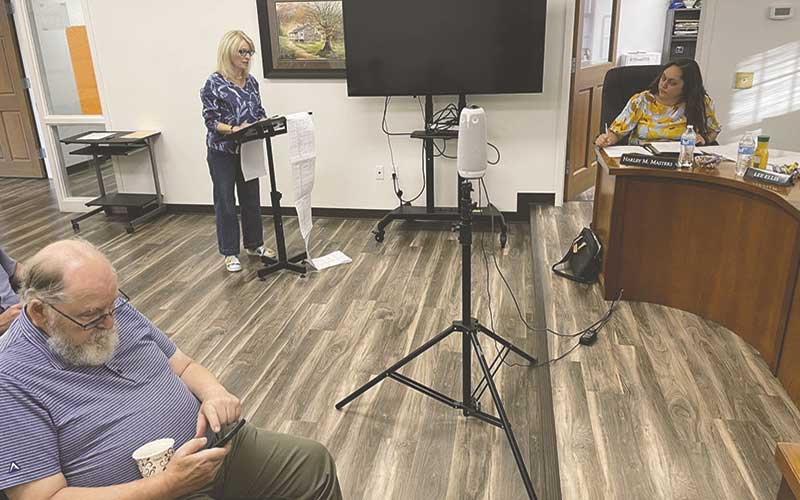
Several Mitchell citizens spoke at the Mitchell County Board of Commissioners last week during the public comment period, expressing concern about the use of Flock Safety cameras in Mitchell County.
The Mitchell County Sherriff’s Office uses Flock automated license-plate readers.
The first speaker, Michael Harrison, discussed comments he has seen about the issue on the internet.
“You shouldn't have anything to worry about if you're not doing anything illegal,” said Harrison. “ There is no right to privacy as you can be seen from a public vantage." These are just a few comments and discussions that flock on local Facebook groups, and most people are choosing to ignore the larger point.”
As is standard in most government meetings, the board members made no direct response to the "remarks made immediately after the public comment portion of the agenda, however, Commissioner Steve Pitman expressed interest in what was said during the “board comments” portion of the agenda, at the very end of the meeting.
“I would just like to thank you guys that came to do a public comment, bringing some attention to something I really had no knowledge of, so I'll do some homework on my own and try to get a little more educated there,” Pitman said. “Thank you all for bringing that to our attention.”
Harrison said that the changes in technology make the invasion of privacy threatened by security and traffic cameras a larger concern than in the past.
“The lack of privacy in public as law was put into place back before ubiquitous video was a thing,” he said. “Back before having security cameras on every corner was a thing. Back before all the cameras were linked into one big network. Back before that network was controlled by AI that can track and collate video data orders of magnitude faster and better than anyone before.”
Harrison suggested that these networked cameras could be vulnerable to hacking.
“There are more than 22 confirmed vulnerabilities in the federal cybersecurity database,” he said. “A camera can be taken over in 30 seconds.”
Harrison further noted that North Carolina law requires the county to audit footage from Flock cameras.
“When was the last time anyone in Mitchell County performed an audit, as required by North Carolina statute, to see how local footage is being used?” Harrison asked. “When is the next scheduled audit, and where will the results be published? These cameras can and have been used for good purposes, but the company behind the cameras is not concerned with the privacy and security of the citizens of Mitchell County. Any further use of Flock cameras in Mitchell needs to be accompanied by the fully informed consent of the citizens of Mitchell County.”
Lea Charlton of Spruce Pine spoke next.
“I live in the Estatoe area where there are a minimum of two of these cameras,” Charlton said. Charlton brought with her a list of abuses of Flock cameras that was several feet long.
“Missouri, a detective stalked his wife using the cameras. Milwaukee, detectives stalked a girlfriend,” she read. “A Georgia police chief used (them) to harass and stalk several people; a Wichita lieutenant stalked his wife.”
A number of the abuses Charlton listed took place in Georgia, including an officer who allegedly accepted a bribe to check on a woman’s license plate number.
“Costa Mesa, California, an officer harassed a woman thousands of times and stalked her using data from the cameras,” she went on. “(In) Kansas, an ex-detective — he was ex — used it to stalk his wife after he was fired, and to commit child sex abuse.”
Jeremy Wise of Mitchell County said that he has been watching live-streams of the commissioners’ meetings.
“I've been following these meetings online, and I want to start by saying I really appreciate the effort you all made to make them more accessible to the public,” Wise said. “I also want to be very clear that this is not a personal attack. Wise expressed concern that even if only those involved in criminal activity are pursued by local law enforcement, there is still a record of the movements of everyone else.
“This system is collecting and storing data on every person in our community, and I believe that decision was made without public input, without clear policies in place, and without most people even knowing what the cameras are,” Wise said. “That's a problem, because this affects every person who lives here every time they leave home and drive on one of our roads. That's not how decisions like this should be made, especially when they involve powerful new surveillance technology. This is not as simple as being for or against the cameras.”"