
‘Bloodletting in These Hills’ opens Friday at Parkway Playhouse for a two-week run
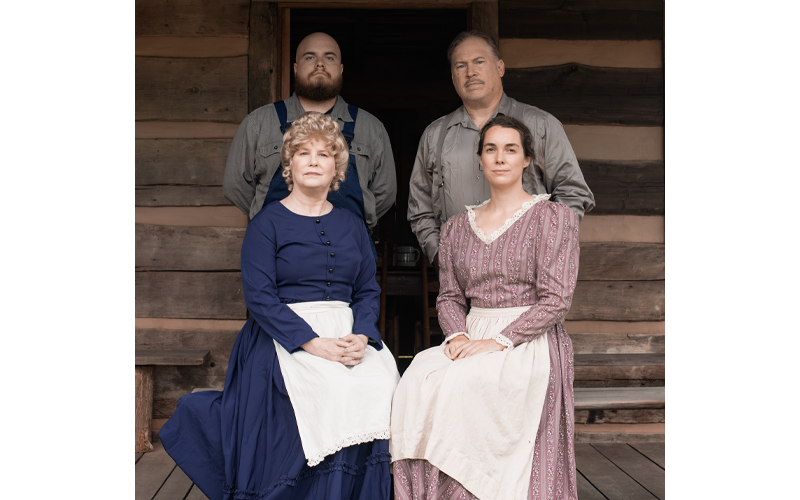
During the protracted miners’ strike in West Virginia’s Cabin Creek and Paint Creek region in 1913, a company storekeeper and his family play out the conflict’s issues inside their home, fueled by divided loyalties. While their interpersonal struggles mirror the crisis outside, the wider violence of the strike continually encroaches upon their safety.
These are some of the themes of “Bloodletting in These Hills,” a new play opening in Burnsville at the Parkway Playhouse. The first showing will be Friday at 7:30 p.m., and the run will continue through Aug. 10.
Winner of Parkway Playhouse’s annual Appalachian Playwriting Festival in 2024, Walter Thinnes’ “Bloodletting in These Hills” grapples with one of the bloodiest episodes in American Labor’s history, in a swath of West Virginia familiar with coalminer strikes and brutal corporate reprisals.
The Paint Creek-Cabin Creek Strike of 1912-1913 might be seen as a prequel to the better-known Battle of Matewan in 1920 (explored in John Sayles’ 1987 film “Matewan”).
During college in the 1970s, Thinnes stumbled on an account of strike in a library book. The level of violence, as well as the bravery of the famous union organizer Mother Jones (whose off-stage presence is felt throughout “Bloodletting”), haunted the playwright.
After his initial encounter with the strike at the library, Thinnes read more history on the events. A few years later, he was able to drive to the Cabin Creek-Paint Creek area to see what he could find.
“It was still an impoverished area,” Thinnes remembered. “But I spoke with local people, and they referred me to another book: ‘Bloodletting in Appalachia’ by Howard B. Lee, who was a lawyer at the time and worked for both the unions and the coal mine owners.”
Lee’s book solidified Thinnes’ interest in the subject, which was reenforced with another chance encounter while reading; an article in the “Miami Herald” alerted Thinnes to the fact that Lee was still alive and well at 103-years-old. Thinnes arranged to meet Lee.
“When I shook his hand as I left it occurred to me that I was shaking the hand that shook the hand of Mother Jones,” Thinnes remembered. “That’s as close as I could get.”
“Bloodletting in These Hills” went through numerous drafts and variations.
“The first version was a polemical account,” Thinnes said. “Mother Jones was on one side of the stage arguing with robber barons — mainly Rockefeller—on the other side. I plopped a family at a dinner table between them as a symbol. It was awful.”
In a subsequent version, Thinnes said, he “shifted from the political issues to the impact on the family.”
This version, titled “Coal Creek,” was chosen for production by a theatre in South Carolina. “They did a great job,” Thinnes said, “but I came away with deep reservations about the script. I rewrote it significantly, getting to the current version.”
After winning last year’s festival, Thinnes has been happy working with the Parkway Playhouse. “They did a terrific job in the readings last year for the festival,” Thinnes said. “I have been very impressed with the talents I have met there and am excited to see the work they will do to bring this script to life.”