Madison Smith
MNJ Intern
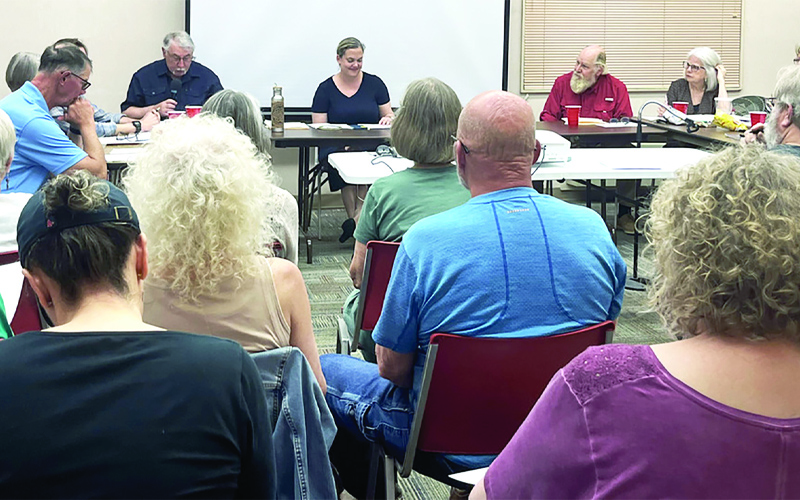
The Avery Mitchell Yancey Regional Library board meeting was held on May 23 at the Spruce Pine Public Library.
The AMY Regional Board has been shrouded in controversy over the past year, due to a pride display at the Yancey County Public Library for Pride Month, which is in June.
Several members of the community took issue with the display and called for the Yancey library to leave the AMY regional system. However, the Yancey library is unable to leave due to a 10-year contract signed in 2021, as well as the library’s funding coming from the AMY partnership.
The board consists of 11 members including Josh Smith, Frank Hughes, Nancy Burleson, Steve Rowland, Michelle Presnell, Christy Edwards, Andrew ‘Buddy’ Waterman, Margaret Teal, chairman Luther Stroup, and Amber Westall Briggs, regional director. Absent from the meeting was Clayton Roberts.
Linda Reynolds, a library consultant from Raleigh, gave a 20-minute board development training. After this, policy changes were discussed. Major policy changes include those to the social media, censorship, and book display policies. All new policies were approved in a 7-3 vote.
The new book display policy states that the final responsibility for library materials is held by the library director. Going forward, in order for displays to be approved they must meet the criteria of the new policy. These criteria include community needs and interests, availability of display space, historical, cultural, or educational significance, budget allowance, connection to other communities of national programs, exhibitions, or events, and relation to library collections, resources, exhibits, and programs.
The Intellectual Freedom and Censorship policy details the library’s right to display controversial materials, whether it be books or in displays, as long as it adheres to the book display policy. The policy also states that “Only parents and legal guardians have the right and responsibility to restrict the access of their children to library resources.”
AMY Regional Library also updated the procedure for the questioning of library displays by patrons. If a complaint is being heard about a specific item, the material will not be taken off the shelves while the case is being reviewed. Complaints are first heard by a staff member, who will take notes and pass them on to the library director. If the director’s decision regarding the compliant is not satisfactory to the patron, the case will then be classified as a formal complaint and will be heard by the board.
Several changes have also been made to the complaint form. To submit a complaint, a person must be a card-carrying member of Avery, Yancey, or Mitchell libraries. The back of the form has also been updated to include what qualifies as a formal complaint, how the director follows through with complaints, a packet of information, collection development and display policies, and a request to review library resources.
The social media policy revision includes new guidelines for what the library can post on social media, as well as guidelines for staff. The policy has been changed to state that “the posts should inform library users about services, resources, programs, events, promote library use, and encourage dialogue between users and library representatives.” The policy also now states that the library has the right to delete public posts or comments that are spam or hateful.
Photographs of book displays will also no longer be shared to social media. Information on new policies can be found on the AMY Website at https://www.amyregionallibrary.org/policies/.
“This last year has been very challenging. I would be remiss if I did not say that,” said Briggs. “I will also say, that from a community perspective — that it has been challenging for many of those in our community in many ways. We hope with these policies that we are implementing that we are moving forward with that, that all boards will have found compromise in what we are suggesting as well as staying true to the First Amendment and the Constitution. Our libraries are for all people, and all books are at our library and available for anyone to check out.”
In addition to new policies, 11 members of the community were given the chance to sign up and give public comments to the board. These were limited to three minutes per person to finish the meeting in a timely manner. The board did not respond to public comments but took notes.