
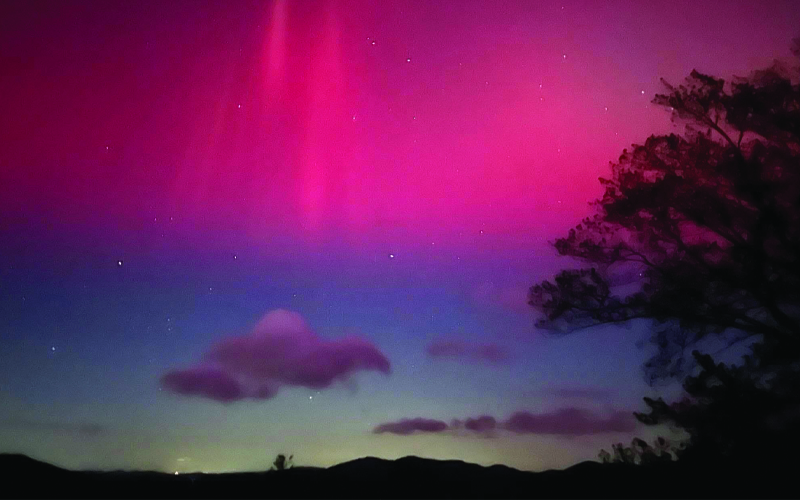
Residents across North Carolina experienced a rare celestial treat as the Northern Lights, or Aurora Borealis, became visible on the night of May 10, continuing into the early hours of May 11 and the night of May 12. This unusual sighting was made possible by the strongest solar storm in recent decades.
The National Oceanic and Atmospheric Administration’s Space Weather Prediction Center had issued a Severe Geomagnetic Storm Watch, the first since 2005, in anticipation of heightened solar activity. This activity stems from coronal mass ejections (CMEs)—massive bubbles of plasma and magnetic fields ejected from the sun, which can travel to Earth within hours.
These geomagnetic storms are significant not only for their visual beauty but also for their potential to affect modern technology. The event has prompted increased monitoring and research into how such solar phenomena can impact Earth’s technological infrastructure.
For those who missed the spectacular display, astronomers recommend staying tuned to updates from space weather forecasts, as conditions could remain favorable for more such occurrences in the near future.