
Mariel Williams
editor@mitchellnews.com
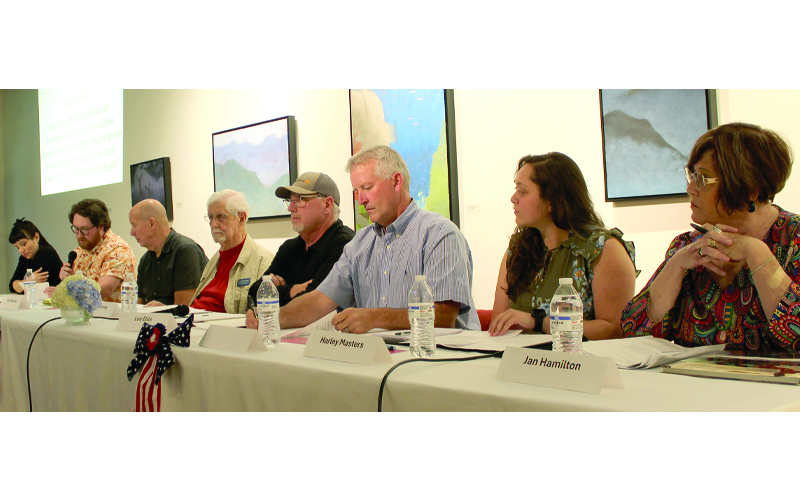
Candidates for Mitchell County Commissioner discussed how to support arts and culture at a forum Thursday — by lowering housing costs and improving internet access, among other issues.
The Orchard at Altapass partnered with Toe River Arts to sponsor the forum, which was held at the latter’s Upper Street (Oak Avenue) gallery in Spruce Pine. The candidates answered several questions about Mitchell County’s culture and heritage, as well as their own connection to the arts, in front of a packed house.
The forum was livestreamed on the internet. Nealy Andrews, executive director of Toe River Arts, and Spencer Bost, executive director of Spruce Pine Downtown, served as moderators for the event.
Housing crunch
After introductions from each of the candidates, Bost opened the issue questions with a discussion of rising housing costs and how that affects local artists.
“The availability of quality, affordable housing for artists and long-time generational residents in rural communities … supports the local economy and enriches the cultural vibrancy of our region,” Bost said. “When artists and younger residents have access to quality housing … it creates opportunities for them to put down roots and become active members of the community.”
Candidate Dale Blevins, a retired teacher and retired Parks & Recreation director, noted that the increase in housing costs is a widespread problem.
“Affordable housing is a problem, not just in Mitchell County, but it is a problem nationwide,” Blevins said.
Blevins suggested that the county should be actively looking for vacant land where housing could be built and investigating what issues with infrastructure might make that land unattractive to developers.
“That is a big key to developers wanting to come here,” he said.
Blevins also suggested getting help from major employers who struggle to attract staff members to an area with limited housing, or applying for grants that could be used to convert buildings such as the vacant Deyton Elementary School into affordable housing.
Candidate Ron McKinney, a Christmas tree farmer, noted that there is already funding available to help people obtain housing, but there simply isn’t enough housing to make that funding useful.
“There are numerous programs in Mitchell County and North Carolina that are designed to provide rent assistance or help with home repairs,” McKinney said. “The problem in Mitchell County is the lack of rental properties and homes that can be purchased for repair.”
McKinney suggested that Mitchell County should establish a Department of Housing in order to address this problem, while informing people of the existence of rental and home purchase assistance programs already in existence.
Candidate Lee Ellis, an insurance agent, also noted that the housing problem is national in scope.
“The issue that I think is sometimes further complicated by folks that come here looking for second … homes,” Ellis said.
Ellis said that while he is open to the county finding a way to improve the housing market, he is concerned that government housing is a long-term commitment for county government that removes property from the tax rolls.
“I don’t think the answer to a problem like this is going to come from local, state or federal government,” he said. “I think the answer is probably going to come from local businesses, the private sector, and I know that the EDC [Economic Development Commission] has had some meetings with local industries about this very subject.
Candidate Bill Hoag, a retired assistant fire chief and current volunteer assistant fire chief, suggested that the county government needs to start with researching a long-term comprehensive plan for the next several years of the county’s future, and this would be a good opportunity to discover housing solutions.
“The second part of that, I would also talk to the county administrator and have them evaluate all the property that Mitchell County owns … and see if any of that land is good to build on,” Hoag said. “We could have a mix of loft housing and multi-family housing. … The county owns it, so we would have the ability to sell it at below tax value, and then set the standard on how and what kind of buildings we let get built.”
Harley Masters, chair of the current Mitchell County Board of Commissioners, noted that a problem like a national housing crisis is too complicated to address in a two-minute response.
Masters talked about what the commissioners are currently doing to address housing, such as seeking proposals to have the local housing market professionally analyzed and also seeking consultants to develop a new capital improvement plan.
Masters said she was very interested in the potential benefits of a new initiative on the housing crunch from the University of North Carolina at Chapel Hill.
“I had a phone call with them today, and they are looking at the challenges of affordable housing, and a piece that I brought to the table is that looks different towards Raleigh, versus here, in rural Mitchell County,” Masters said.
Candidate Jan Hamilton, a retired social worker, noted that she has gotten to know a number of new local residents who have moved here to escape even higher home prices in Asheville.
“I think we need to have a focus group … to look at … how much land do we have, what could we put on that land, what could we sell it for,” Hamilton said. “I live in a beautiful apartment — this county might want to look at more apartments and condominiums for people coming in; they’re more manageable cost-wise.”
Internet access
Another question for the panel dealt with the difficulties that artists and other small business owners face when their internet access is limited. Bost noted that artists sometimes have to travel to libraries or other public spaces in order to connect with customers online.
Blevins noted that there are a number of grants available to improve internet access in rural areas, including a grant that the Avery-Mitchell-Yancey Regional Library is going to use to provide people with internet hotspots that can be checked out.
“Those things are trying to be solved,” he said. “There’s a lot of things happening now in Mitchell County, it just takes time.”
McKinney said that he is not familiar with what’s being done to address the internet access problem.
“Since my own internet service is terrible, I understand the problems that many people are having,” McKinney said.
Ellis expressed concern for how lack of internet affects schoolchildren trying to keep up with classwork and agreed that solving the problem will take time.
“It’s a nationwide problem for rural areas, and it’s not going to be a quick fix,” Ellis said.
Hoag suggested that this problem would be another thing that a comprehensive master plan for the county’s future could be used to prepare for.
“That would be one of the most important things, with affordable housing, that we need to address,” he said.
Masters said that the county has made considerable progress in improving internet in the past four years, and the Board of Commissioners recently committed to seek more funding to help improve internet access through the Stop-Gap Solutions Program administered by the North Carolina Department of Information Technology.
“We’re not where we need to be, but we’re better than we were four years ago,” she said.
Hamilton agreed with McKinney that there is a wide variety in internet access levels within the county. She suggested the county could contact different internet providers and ask each one to propose what they could do to provide better service, in order to acquire more customers for themselves.
“Make it a competition,” Hamilton said.