
Support agencies weigh in on how the funds should be spent
Mariel Williams
editor@mitchellnews.com
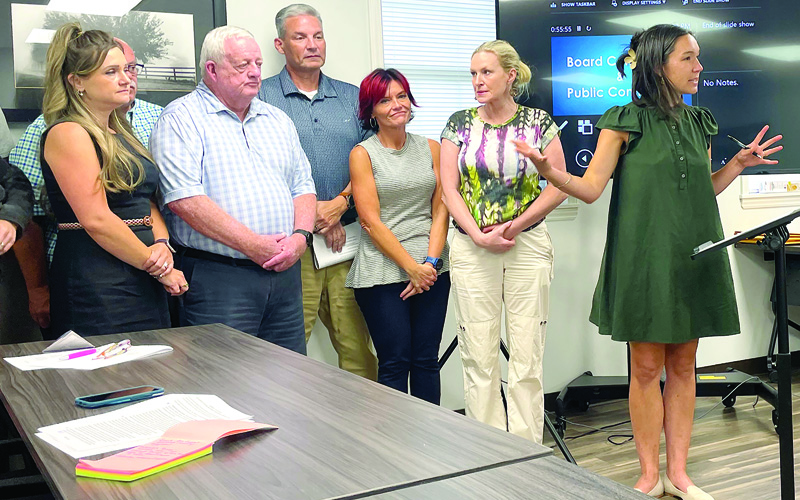
The Mitchell County Board of Commissioners held a special meeting last week to hear public comments on how to spend settlement funds from a series of lawsuits accusing medicine manufacturers and sellers of over-distributing narcotic medications in such a way as was likely to increase addiction and overdoses.
The special session was unusually well-attended, filling up the Economic Development Commission meeting room at the Mitchell County administration building in Bakersville.
County Finance Officer Christy Young opened the meeting with a presentation on the opioid crisis and the restrictions on how the settlement funds can be spent.
“The opioid epidemic in North Carolina has been a huge thing,” Young said. “Nearly 12 North Carolinians died each day from drug overdoses in 2022. … Local governments have spent an untold amount of money on related costs.”
Young said the financial impact of increases in drug abuse has affected health care, social services, criminal justice and other aspects of local government.
Nationally, the settlement funds in multiple opioid lawsuits totals $56 billion.
“Of that $56 billion, North Carolina received $1.5 billion, and that has been passed down to the local governments,” Young said. “All 100 counties in North Carolina joined in this lawsuit with the pharmaceutical companies.”
Now, Young said, local governments have to decide how best to spend the funding, which is earmarked specifically to combat drug abuse and related problems.
“The hope is the local governments … can combat this problem,” Young said. “We are going to get anticipated funding, as of right now, of $3.6 million.”
The money will be doled out over a period of 18 years. Additionally, there are very specific and lengthy restrictions on how the money can be spent, and the county finance department is working to make sure that money is not budgeted for any expenses that might be rejected by the state government, leaving county taxpayers footing the bill.
“We have to give a description of why we chose this and how we’re going to use this particular program to combat this issue,” Young said. “We don’t ever want it to come back on our taxpayers [making them] responsible for replacing those funds that we’ve spent — so we want to be super, super cautious with how we allocate these funds and make sure we’re within the guidelines.”
Lisa Schultz of SEARCH WNC (Sustaining Essential and Rural Health Care Western North Carolina) encouraged the board to consider what goals they want to achieve in the next 18 years of anti-opioid abuse spending.
“When we did strategic planning … one of the things that came up and then just quickly went to the side because it’s totally unrealistic was recovery housing,” Schultz said. “[It’s] absolutely needed.”
Schultz suggested that the board should consider setting aside some of the funds for a “big need,” something that would seem otherwise unrealistic, such as housing.
Multiple community members who spoke mentioned the need for general financial assistance for addicts in the process of getting clean — many are uneasy about going into a residential rehabilitation facility because they might be unable to pay their bills while they are away.
Many, if not most, who attended the meeting came as staff members or volunteers serving with area nonprofits. When Jay Carver stood up to speak board Chair Harley Masters asked if he represented a particular group.
“No ma’am, I just — I got ideas,” Carver said.
Carver said he was inspired by both personal experience and by working at a local prison.
“I go to Celebrate Recovery,” Carver said. “I was an alcoholic for a long time — I was a closet alcoholic, in other words I drank at home, the next day I’d go to work.”
Carver described the opioid epidemic as the work of Satan. Other recovering addicts who spoke at the meeting also focused on the spiritual aspect of addiction and recovery.
“I work up at the prison now — I asked one young man, he was getting out … I said where are you from? He said Asheville,” Carver remembered. “I said, where you going when you get out? He said, I guess I’ll go back on the street.”
Carver recommended using some settlement funds to help those getting out of prison.
“We’ve got people living like that down here … they’re living under these bridges, they’re living all around, they’re camping out in the woods on people’s property,” Carver said. “We need like a halfway house and a homeless shelter.”
Carver suggested that some of the empty school buildings in the county could be used for either a halfway house or a homeless shelter.
“Right there is a perfect opportunity,” he said.
The commissioners also shared their ideas and concerns, many of which focused on helping children and youth impacted by drug use. Commissioner Steve Pittman spoke about how addiction and overdose had impacted his family, as did Masters.
“Myself, personally, I grew up in a household with drug activity,” Masters said.
Commissioner Brandon Pittman mentioned being impressed by the community response.
“I think this is the most people I’ve ever seen at a commissioners’ meeting that wasn’t mad at us,” Pittman said.