
Steffen Silvis
MNJ Contributor
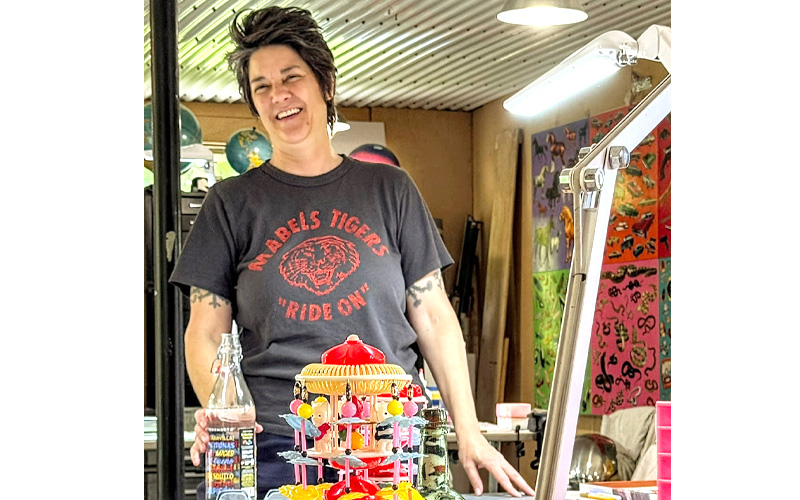
By any estimation, 2025 has so far been a banner year for the Spruce Pine artist Anne Lemanski.
In February, one of her best-known sculptures, “Stella Terra,” a life-sized horse made of copper rod, Mohawk cover board, inkjet print on paper, and artificial sinew, was permanently installed in the Charlotte-Mecklenburg Library’s new University City Regional branch.
Just prior to that, the Raleigh Fine Arts Society unanimously chose Lemanski’s proposal for a 26-foot-tall sculpture, titled “Sophia Fortuna,” to mark the Society’s 60th anniversary.
Upon completion of the sculpture, “Sophia Fortuna” will be permanently placed in Raleigh’s Dix Park.
Until “Sophia Fortuna’s” unveiling later this year, Lemanski’s work can also be found in a current exhibit at the Mint Museum-Randolph in Charlotte until Aug. 10, while her sculpture titled “Hoozit & Piggy” appears at Charlotte’s SOCO Gallery as part of its 10th anniversary exhibit “Layer Cake,” which opened last Thursday.
Many regional museums have added Lemanski to their permanent collections as well. You could even see a Lemanski piece inside the United States’ Embassy in Karachi, Pakistan, although Charlotte is admittedly closer.
A native of Michigan, Lemanski made her way to Chicago, where she started her life as an artist, while working in a framing shop popular with artists and collectors needing their art framed. Wanting to establish herself as a full-time artist instead of establish herself as a full-time artist instead of a professional framer, Lemanski began to consider art residencies that would help her realize her goal.
“I did some research and found two residencies to apply to that sounded exactly what I was looking for,” Lemanski said in an interview at her Spruce Pine studio. “One was at Penland, while the other was in Roswell, New Mexico.”
It was Penland School of Craft that called her first to offer her one of their three-year residencies.
Having not been to North Carolina since childhood, Lemanski came to Penland to see the school and to sign the necessary papers for the residency. The school’s philosophy, established by its second director, Bill Brown, appealed to Lemanski.
“Brown developed the program in such a way as to intrigue artists into staying on in the area after their residencies,” Lemanski said. “Well, it sure worked for me.”
She returned to Chicago, packed up, and held a successful fundraiser for her departure (“I might have invented ‘Go-Fund-Me’ without realizing it,” Lemanski said, laughing).
At Penland, she quickly found her footing as an artist and a community that appreciated and supported her. Since the end of her residency, Spruce Pine has been home.
Lately, she’s decided to put sculpting aside to concentrate on her collage, which she recently announced at a Penland roundtable of artists. While her collages have found their own collectors, she has also produced a popular, collaged wallpaper line for the Peg Noriss design company.
Who needs to go to Karachi, when you can see Lemanski’s work on your own dining room walls?