
Mitchell is navigating a boom in building projects
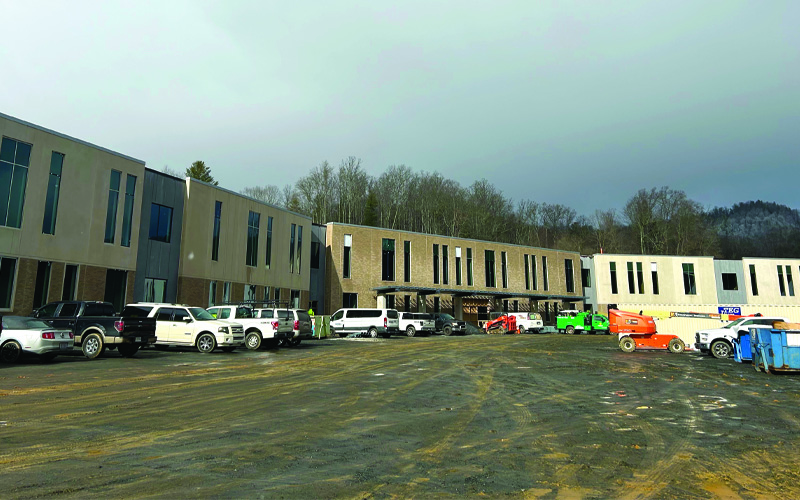
Building is booming in Mitchell County. A quick drive through the area easily highlights the rapid developments in construction. From the expansion of the Blue Ridge Boutique Hotel to the new Mitchell County YMCA, and from the Three Peaks Enrichment Center in Spruce Pine to the new middle school in Ledger, development is evident. Bakersville is also witnessing significant growth with its new recreational complex, adjoining facilities, and a law enforcement center. Not to mention the $200 million expansion at the Sibelco facility in Spruce Pine, that began in 2023 and is slated for completion in 2025.
In 2023 alone, the Mitchell County Building Inspections department issued a striking 522 residential building permits with a total valuation of $15,001,643, and 217 commercial building permits valued at $103,227,486. This robust activity underscores the county’s growth trajectory.
The majority of building inspections for these projects fall on the county’s inspections department, despite some engineers from construction firms handling certain aspects. The commercial sector, with over $100 million in construction, keeps the inspections department particularly busy. The process involves a range of tasks, from checking the installation of HVAC units to overseeing complex construction details. The most important aspect of the process: timing. For contractors to keep jobs moving, everything has to work in sequence. From pouring concrete to putting up walls, timing is critical. You can’t move forward until the last step is approved.
Misty Sparks, the administrative assistant at the Mitchell County Inspections office, emphasizes their efficiency in meeting North Carolina’s requirement of completing inspections within three days of a request. According to Sparks, once they receive a request for inspection, it’s scheduled, usually for the same day or the day requested.
“We know the [time] limitation and we get them done,” said Sparks. “This procedure has been in place for at least the last 16 plus years. It was in place when I started working in this office.”
Meeting the demand
Meeting the rising demand for building inspections in Mitchell and other Western North Carolina counties is challenging. Dillion Phillips, a Level 1 inspector who was hired in October 2023 to fill a vacancy left when the former building inspector – a Level 3 departed, together with Andrew Brewer, the county fire inspector who dedicates 50% of his time to inspections, are striving to keep up with the demand, especially for Level 1 and 2 inspections.
On average, the county completes nine Level 3 inspections per week, currently managed by Level 3 inspectors who are contracted from neighboring counties. According to County Manager Allen Cook, these inspectors are paid $50 an hour plus IRS travel rate for mileage incurred, with a budget of approximately $2,500 per month allocated for these contracted services. Sparks manages and schedules the contracted inspectors, ensuring smooth coordination of inspections.
Cook anticipates revisiting funding for these contracted services in the 2024-2025 budget due to the need for Level 3 inspections. He also highlights Phillips’ ongoing certification process, but it takes time.
“By the summer Phillips will be a probationary Level 2 inspector,” says Cook. “On average it takes 4-5 years for a Level 1 inspector to progress to a Level 3, based on state requirements.” Cook anticipates Phillips will hit that Level 3 position by the end of 2028.
Jon England, an inspector from neighboring Yancey County, said there is a challenge regionally in finding inspectors.
“It seems very difficult to find a Level 3 inspector in our area,” England explains. “In fact, we posted an inspector position back in November. We had several applicants but none of them held any NC Inspector Certificates. This means we would have to start a new hire out at base pay until they were able to obtain at least a Level 1 certification. We have not filled the position yet.”
Phillips, reflecting on his new role, highlights the transition challenges and the importance of establishing trust with contractors and builders. He has a diverse background in construction trades and a commitment to Mitchell County’s development. Looking ahead to 2025, Phillips foresees challenges related to the county’s rugged landscape and the scarcity of suitable real estate, which could impact affordable housing development and adherence to building codes.