
Businesses small and large struggle to recover from storm’s impacts
Randy Foster
editor@cherokeescout.com
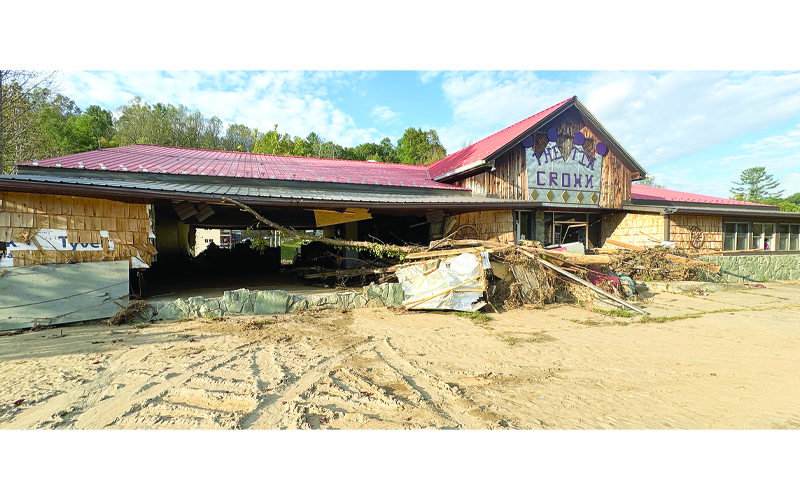
The Tin Crow, a consignment store in Micaville on U.S. 19 East/N.C. 80 halfway between Spruce Pine and Burnsville, posted optimistically on its Facebook page on Thursday, Sept. 26.
“The shop will be closed Friday, September 27th due to weather,” said the statement, posted about 90 minutes before Category 4 Hurricane Helene made landfall near Perry, Florida.
Helene was a tropical storm by the time it reached western North Carolina, but the National Weather Service called it a once-in-a-thousand-year storm for the region.
Areas in and around Mitchell County received two feet of rainfall over a 24-hour period.
In Micaville, usually placid Little Crabtree Creek and tributary Ayles Creek became raging torrents, scouring the landscape and leaving devastation in the storm’s wake.
The Tin Crow was gutted, all its inventory washed downriver. A road-facing wall collapsed, as did the main floor and back wall.
It didn’t open Saturday.
A shopping center across the highway was similarly ravaged. Casualties included Maples, a coffee shop with a 4.9-out-of-5 rating on Google, Underwood & Weld Co., fitness center Body Tribe, and Micaville Outpost, a general store with Appalachian-themed merchandise.
Cars, pickup trucks and school buses were caught up in the flood, their wreckage mired in the mud. A storage tank was tipped on its side and wedged against a pile of debris.
Micaville became the gateway to devastation on the approach to neighboring Mitchell County, which lost all contact with the outside world during the days that followed. Businesses on Locust Street in downtown Spruce Pine were flooded by the swollen North Toe River, as was the Ingles supermarket and gas station off Greenwood Road, to name a few examples.
Once connections were restored, news of devastation reached the outside world and help started to arrive and a bigger picture emerged.
Micaville was devastated, as was Spruce Pine and scores of cities, towns and communities throughout a 25-county swath of western North Carolina. But in Mitchell and McDowell counties, impacts had global implications.
The world stage
Helene did more than destroy local businesses. It interrupted two local industries with national and global implications – pure quartz operations near Spruce Pine in Mitchell County vital to global technology manufacturing, and Baxter Healthcare in Marion in McDowell County that produces the majority of IV products used in the United States.
It was quartz that grabbed the attention of global markets. Online news site Axios ran with this headline: “Helene took out an N.C. town the entire tech world relies on.”
A disruption in Spruce Pine quartz had the potential to disrupt technology industries around the world. Spruce Pine quartz is valued for its high melting point, chemical inertness, low thermal expansion and purity.
“It is uniquely prized for its chemical composition,” according to Quartz Corp, which operates one of two quartz operations in Mitchell County.
“High purity quartz sand has the distinct physical properties to become a successful crucible. Quartz crucibles are a critical component in the manufacture of photovoltaic cells and semiconductor chips. They are used to grow ingots that are then sliced and polished into ultra-thin wafers,” according to Quartz Corp.
On Oct. 9, Belgium-based Sibelco, which operates the larger of two quartz operations in Mitchell County and is the county’s the largest private employer, announced it resumed shipments of the vital mineral and that all its workers survived Helene.
Sibelco also established a foundation to help rebuild homes and businesses in the Spruce Pine area, where about two-thirds of the population is directly or indirectly involved in quartz production.
Norway-based Quartz Corp., the county’s 10th largest employer, shut down operations the day before Helene made landfall and remained closed.
“Hurricane Helene has severely hit our Spruce Pine community which is currently facing multiple challenges from flooding, and power and communication outages,” the company said in a news release. “It is a dramatic situation for the region.
“Our focus is to ensure that our employees and their families are safe. It is with an immense relieve that we now have been able to make contact with all employees. In addition to this, our teams are joining the local task forces to try to restore the most basic services and bring further supplies to Spruce Pine.
“Operations at our facilities were stopped on Sept. 26 in preparation of the event and we have no visibility on when they will restart. This is second order of priority. Our top priority remains the health and safety of our employees and their families.”
IV supplies
Mass casualties from back-to-back Category 4 hurricanes in the South put a strain on the national supply of intravenous fluids to hospitals and dialysis centers, but Helene also disrupted production of IV products at the Baxter Healthcare plant in North Cove north of Marion that produces a substantial portion of those products for the nation.
“Baxter’s North Cove manufacturing site was significantly impacted by the rain and storm surge from Hurricane Helene, which was unprecedented in Western North Carolina and resulted in water flooding the facility,” Illinois-based Baxter announced.
“Baxter continues to scale production across its global locations and is working closely with FDA (Food and Drug Administration) on temporary importation of products to increase available inventory. Based on 1) the current status of our remediation efforts, 2) our expectations regarding our ability to reallocate capacity from other Baxter facilities, and 3) initiation of temporary importation on certain products, our goal is to restart North Cove production in phases and return to 90% to 100% allocation of certain IV solution product codes by the end of 2024.”
Other impacts
Helene destroyed miles of railroad track used to transport quartz.
CSX, a Class 1 railroad that serves major markets in the eastern United States, reported that its Blue Ridge Subdivision “is experiencing significant flooding and bridge damage, leading to a major outage.”
The week following Helene, crews were on scene repairing damaged sections of track and rebuilding sections that were destroyed. A repair crew worker said the total cost would be hundreds of millions of dollars.
Our State Magazine featured fall foliage tourism in its current edition and published articles about communities throughout the region. Ironically, its map of covered communities was nearly identical to maps of counties devastated by Tropical Storm Helene.
Fall foliage tourism is a $1 billion industry in North Carolina, according to an Appalachian State University study. According to the study, the typical family of four could spend anywhere between $400 and $1,000 on a trip.
“That’s no small chump change and such expenditures are critical to the success of businesses in the mountains, many of whom depend on fall tourism to balance their books,” according to the report.
While fall 2024 may be a bust, the influx of labor and recovery dollars to rebuild the region over the next year or two may more than make up for it.