
Sort storm debris and move to side of road
Mariel Williams
editor@mitchellnews.com
Local governments have arranged for storm debris to be removed as long as it is located on right-of-way alongside state and town roads.
The Mitchell County Board of Commissioners discussed the debris removal terms at its meeting last week. The board approved a debris removal contract with Southern Debris Removal, and a debris monitoring contract with Debris Tech.
A debris monitoring contract is required to receive federal reimbursement for debris removal. The debris monitoring company will attempt to ensure that the debris removal is done in a way that complies with the contract and federal regulations.
County Manager Allen Cook said that the debris will be removed in a way that complies with environmental regulations, and will be incinerated, wood-chipped, taken to a landfill, or otherwise disposed of.
“All this is done in an environmentally correct manner,” Cook said.
Cook said that the debris removal program will also involve clearing the state’s right-of-way along roads of brush and weeds that are growing there.
“The trees that are not on the white line anymore, they’ll be cut 20 feet back from the edge of the roads,” Cook said. “They’re going to make it where a fire truck can get up there, going to make it to where emergency management can get through there.”
Cook said that while the state right-of-way is 20 feet, the right-of-way on town roads may be different. County attorney Four Eggers emphasized that this would not impact private driveways and private subdivision roads — all debris needs to be moved to government right-of-way.
“For folks concerned about private property rights, if you don’t want them to cut that far up, folks can cut it themselves and take care of it,” Eggers said. “They will cut whatever the right-of-way is. Usually that’s the top of the bank, but they won’t go beyond 20 feet.”
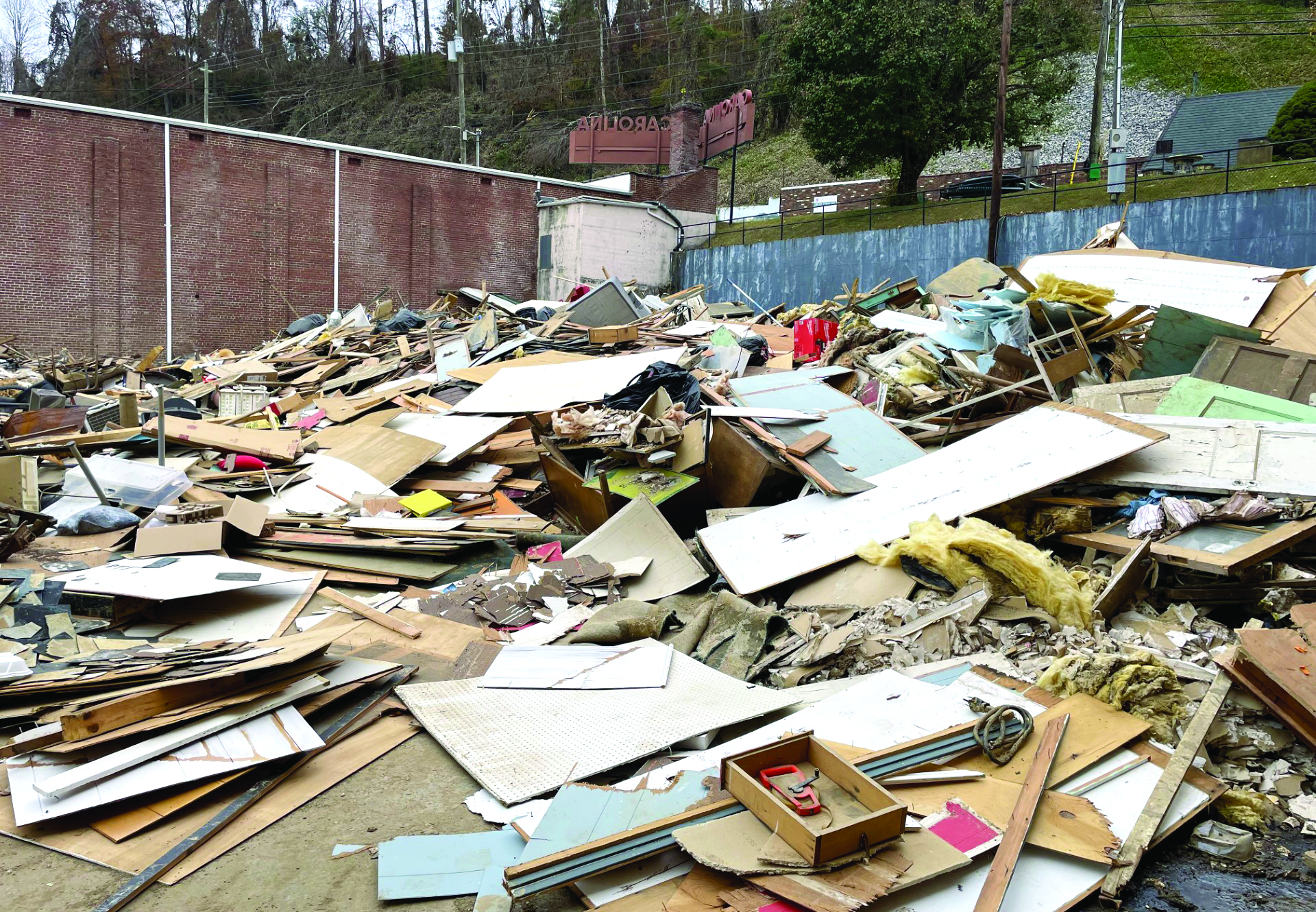
In order to take advantage of the debris removal, residents are expected to sort the debris from their properties into three specific types of waste: trees and brush, white goods (appliances such as refrigerators, washing machines), and construction debris from damaged buildings.
“You can’t have a debris pile mixed with household garbage mixed with construction debris,” Cook said. “You’ve got to have woody lumber, woody timber like trees and brush — that’s one pile; construction debris is another pile; white goods is another pile.”
Cook said that debris removal will begin slowly but soon and will increase steadily over the next two weeks.
“A lot of the debris removal [companies] were down in Florida for the Hurricane [Milton],”
Cook said. “Not to say bad about North Carolina, but the state of Florida paid a little better … so all these companies were kind of [headed] over that way.”
“In three weeks you’ll see a lot more [debris removal] trucks on the road,” Cook said.
Cook said the debris removal and monitoring will cost between $22 and $23 million, but the county expects to be reimbursed with federal disaster relief money.
In response to a question from commissioner Jeff Harding, Eggers noted that Debris Tech has spoken of hiring local subcontractors to help with the work but the county would not be part of that hiring process.
“They will be looking to hire local folks to train them and fill up that role,” Eggers said.
Eggers also noted that this contract does not give the North Carolina Department of Transportation any additional right-of-way; the state’s right to clear a certain amount of space along state roads remains the same as what it was before the storm.
Board Chair Harley Masters asked if the debris removal would cause traffic problems, particularly when trucks begin coming into the county to pick up Christmas trees in coming months. Cook said that he has communicated this issue with tree farmers and the debris removers and there is an intention to mitigate the problem, however that won’t stop outside truck drivers coming to pick up trees from causing traffic snags unwittingly.