
Programs tackle food insecurity
According to statistics from Feeding America, many adults and children in Mitchell County lack enough food to eat.
To tackle the issue, county residents, churches, and local businesses provide free food through community gardens, food pantries, food banks, and meal programs. Even though some of these efforts have been operating for decades, food insecurity persists.
Feeding America, an organization that tracks food insecurity statistics in communities around the country, reported that in 2023, Mitchell County’s food insecurity rate was 17 percent, as compared to 15 percent for all of North Carolina and 14.3 percent nationwide.
In 2022, it was estimated that 18 percent of children under 18 had limited or uncertain access to adequate food. The county also experienced an annual food budget shortfall of $1,587,000 in 2023.
These statistics are available at https://map.feedingamerica.org/county/2023/overall/north-carolina/county/mitchell.
Making it more difficult to address food
insecurity in the county and across the country, the federal government has canceled the Local Food Purchase Assistance (LFPA) program and the Local Food for Schools Cooperative Agreement Program (LFS). These USDA programs allocated almost $1 billion in funding for food banks like Manna FoodBank to purchase fresh produce, meat, eggs, and dairy products from local and regional farmers.
Manna, which serves 16 Western North Carolina counties, distributes the food to local food pantries where low-income families can pick up the free food.
From July 2024 to April 2025, Manna provided on average 11,900 pounds of food, said Micah Chrisman, Manna’s director of marketing and communications. When broken down, that food provided 928 meals a month, which resulted in a total of 3,400 county residents being fed in the last 10 months, Chrisman said.
While Manna’s goal is to find ways to continue working with farmers, ultimately, it comes down to people getting involved.
“We’re honestly trying to encourage people to reach out to their legislators, their representatives, to try and reinstate the funding for this at the state and federal level,” Chrisman said.
The following are county organizations that offer free food. For statistical purposes, Manna FoodBank partners are required to ask for the name, county, and how many people are in the household when registering for assistance.
Food pantries and food banks
One of Manna’s partners is the Cry of A Child Mission International food pantry, which was founded by David Copus and his wife, Jackie, in 2000. For about four years, they lived in Haiti, building churches, setting up clinics, and developing two separate feeding programs.
Eventually, they returned to the Mitchell area and now serve between 350 to 375 families per month at their Buladean food pantry. While the organization still has missionaries in Haiti, their main purpose is the local food pantry, and its mission is booming.
“Every time we’re open, we have 10 to 15 new families,” Copus said. “We’re busting at the seams; there’s a lot of need right now.”
Edward Douglas, 97, has been shopping at the pantry once a week for two years. He is a World War II vet who lives on a small pension and social security. His wife, Rosemary, died two years ago, which meant Douglas was now responsible for making his meals.
“I’m learning to cook,” Douglas said. “So, I get all instant things.”
And picking up food at the food pantry has made his life much easier.
“It has helped me greatly,” Douglas said. “I don’t know what I’d do without it.”
The Mission’s food pantry is open every Wednesday, 10 a.m. to 2 p.m. and every other Saturday (beginning June 14), 10:30 a.m. to 12:30 p.m. For more information, call (423) 202-0182.
Mitchell County Shepherd’s Staff, which recently moved into the TRACTOR Food and Farms’ building in Spruce Pine, is another Manna FoodBank partner that has been serving Mitchell County for more than 40 years.
Rosa Sistare, general manager, said they serve about 100 people a day, and that there are several reasons why people are having difficulties feeding themselves.
“Most of the time they end up with no jobs because of the storm,” Sistare said. “Some businesses were not able to come back. And also the cost of living.”
In addition to the Manna’s FoodBank, Sistare said, local churches and human service organizations like Crestview Baptist Church in Lenoir, the Reconciliation House in Burnsville, as well as Walmart and Dollar General in Spruce Pine, supply food, baby formula, detergent, diapers, paper towels and toilet paper for the food pantry, Sistare said.
Shepherd’s Staff, including all its volunteers, Sistare said, is dedicated to serving the community.
“I would like the community to know that what we are doing here is not just providing food for people. We provide love, respect, understanding, and kindness,” she said.
Store hours are Monday: 9 a.m. to 3 p.m.; Tuesday: 9 a.m. to 3 p.m.; and Thursday: 9 a.m. to 3 p.m. For information, visit https://www.mcshepherdsstaff.org/ or call (828) 385-6153
Ave Maria Ministries Food Pantry, which is affiliated with St. Lucien Catholic Church, is located at 679 Summit Ave. in Spruce Pine. They are open Wednesday from 10 a.m. to 2 p.m., and offer eggs, margarine, bread, cereal, canned goods, produce, toiletries and personal hygiene products.
For information, call (828) 898-6900 or visit https://www.facebook.com/avemariafoodpantry/about.
TRACTOR Food & Farms is located in Spruce Pine, and began its operations in 2013 with the mission to “feed people, pay farmers.”
“We focus on getting food to people who need it and paying farmers fairly in the process,” said Dru Zucchino, executive director. “Making sure they get a living wage and can run their farm businesses, while feeding people.”
While TRACTOR is a Manna FoodBank partner, their primary source of revenue in order to buy food from farmers comes from USDA grants, and sales programs like their online community supported agriculture (CSA) program. This means they are not totally dependent on government subsidizes, which are volatile and unreliable.
“It’s not practical for us to build our model based on what the government might allow us to do and what we’d actually need to be doing,” Zucchino said.
In 2024, through their Healthy Harvest Program, TRACTOR Food & Farms was able to distribute 123 tons of seasonal community-grown produce across Western North Carolina and to local community partners like Shepherd’s Staff and Mitchell Giving Gardens.
But with funds from the government being permanently shut down many food banks and pantries are facing a bleak future keeping low-income families fed. TRACTOR’s leadership feels, however, that while the cuts will have an impact on their ability to provide food to those in need, they can still consider other options.
“Like LFPA, for example, since that’s been cut for next year, it will severely impact how many people we will be able to serve,” said Sierra Bryant, director of operations. “But, our mission as an organization is to find alternate funding to try to bridge the gap before next year.”
TRACTOR’s CSA is a weekly online subscription that provides locally grown produce, meat, eggs, and dairy for those who can pay as well as for those who need assistance. Boxes come in small, large, family, and grocery haul sizes and may be customized each week based on what’s available.
Members order online and can pick up their boxes at a designated location, or have their boxes delivered. For more information, visit https://tractorfoodandfarms.com/about-us
Meal programs
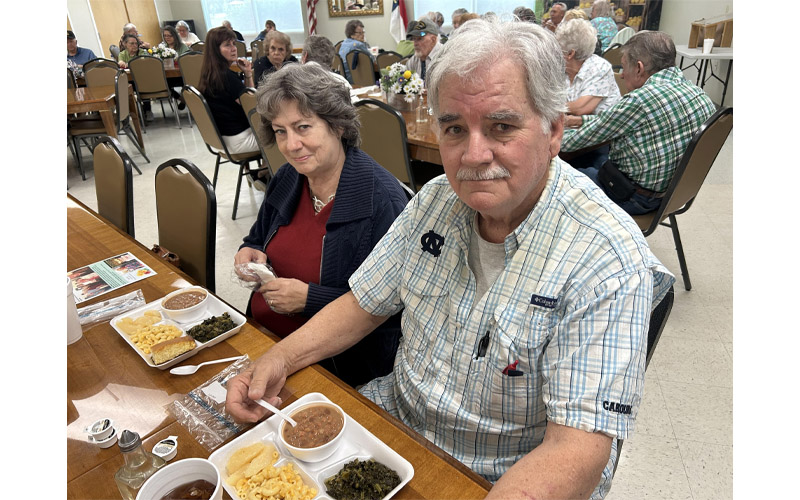
Mitchell County Senior Center serves free lunches Monday through Friday, starting at 11:30 a.m. for seniors 60 years old or older. Since July of last year, the center has served more than 7,000 meals and provided 2,000 rides for people unable to drive to the center and back.
Revenue comes from federal and state programs, private donations, and churches. While their funding will last until the end of the year, next year they may have to make changes.
“Some senior centers limit how many they will feed a day,” said Director Kathy Garland. “Others say, everybody has to give a dollar and a half to eat, to make it stretch the whole year. I don’t know which we’ll do yet.”
Coming to the center, Garland said, helps seniors financially and socially.
“I think coming here helps in so many ways because the socialization affects depression,” she said. “It affects your physical health; it affects your financial health.”
Richard and Marjean Benton, who live in Bakersville, have been coming to the center for several years.
“We love the hospitality, the food and meeting friends,” Richard said.
And Kathy enjoys the activities.
“They have a wide variety of things for the seniors, they have the different exercise classes, a craft room …so many things,” Kathy said.
Since they’re living on Social Security, Richard said, they still work occasionally.
“We couldn’t make ends meet with just Social Security. That’s why I’ve continued to keep working and save up enough to make ends meet,” he said.
Coming to the center’s lunch program helps, he added.
In addition to the center’s lunch program, the center’s Meals on Wheels volunteers delivered 12,000 meals last year. The center is located at 152 Ledger School Road in Bakersville. For information, call (828) 688-3019 or visit https://www.mitchellcountync.gov/departments/senior-center/
Community gardens and markets
Mitchell Giving Gardens’ summer harvest table program begins in June and runs through September. The events are scheduled for the second and fourth Friday of each month from 4:30 to 6:30 p.m.
Harvest table events will be held at Trinity Episcopal Church or in the garden at Riverside Park. The first one or two events will be held in Trinity Episcopal as the park is still being cleaned up.
Those interested in free vegetables should bring bags. Volunteers can arrive at 3:30 p.m. to help set up. For updates, visit the Facebook page Mitchell Giving Gardens and Instagram at @mitchell_giving_gardens.
Dig In! Harvest Share is a free, walk-up market open to everyone Wednesdays from 10 a.m. to 12 p.m. at West Burnsville Baptist Church from May 31 until late fall at 222 W. Burnsville Church Road in Burnsville. For information, visit https://diginyancey.org/what-we-do/
Cosecha Para El Pueblo is a free market held monthly and open to everyone, celebrating the Latino community and food traditions. Cosecha offers resh local vegetables. The food pantry is open once a month, and the dates are: Aug. 15, Sept. 20, Oct. 18, and Nov.15, from 5 to 7 p.m. at Burnsville Elementary School, 345 Burnsville School Road in Burnsville.